Essay · June 28, 2026
250 Years of Contradiction
Reflections from a Los Angeles run, in the week of America's 250th.

Running through Los Angeles recently, I couldn't stop thinking about how impossible America is to neatly describe.
One block felt like the future. The next felt like it belonged to another country entirely. A dozen languages on the same sidewalk. Neighborhoods carrying wildly different stories. Extraordinary wealth alongside visible struggle. Innovation and dysfunction sharing the same intersection, often in the same building.
It is easy to let that complexity harden into cynicism. I get the impulse. The headlines amplify the worst of us. The daily grind is real. The argument about what this country is supposed to be never quite ends, and at some point most people just get tired of having it.
Instead, I found myself leaning into it.
A country that has never been simple
As America celebrates its 250th birthday this week, I am less interested in pretending we are simple than in appreciating that we have never been. This has always been a country of contradictions, constantly absorbing new people, new ideas, and new ambitions while arguing endlessly about what it should become.
The argument is exhausting. It is also the thing.
You do not get a country that re-invents itself every generation without disagreement. You do not get the kind of churn that produces both the Model T and the iPhone, both the moon landing and the iPhone, both jazz and hip-hop and the internet and the next thing nobody has imagined yet, without a permanent low-grade civic fight about who we are and where we are going. The fight is the price of the dynamism.
I think about that a lot when I am running.
What the visitors saw
Then the World Cup arrived.
I went. I sat in SoFi Stadium with seventy thousand other people from somewhere on the planet, watched the opening ceremony, watched the crowd, and felt something I had not quite felt in a while: a room full of people genuinely happy to be here.
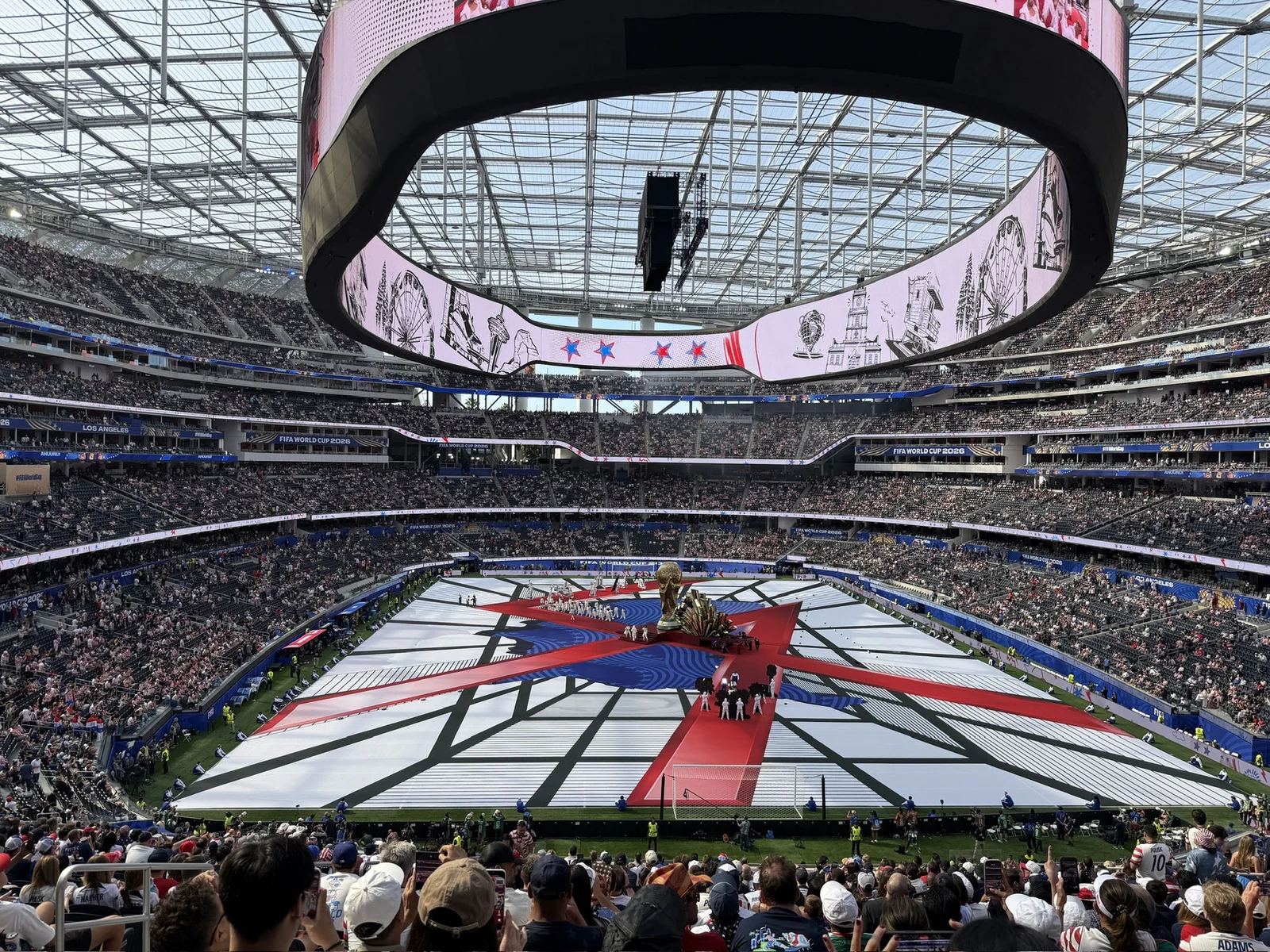
One of my favorite parts of the tournament was reading post after post from foreign supporters describing some version of the same observation: the America I experienced was not the America I expected. They talked about welcoming people. Cities full of energy. Strangers offering directions, food, rides, beds. A country that felt far more optimistic in person than the one they had pieced together from a distance.
It reminded me that America often looks different when you are living inside the noise than when you are seeing it from the outside.
The argument I described above, the exhausting one, is loud. It dominates the feeds. It is most of what other countries see of us. But it is not most of what actually happens here on a Tuesday.
Reinvention as a national talent
Our greatest strength has never been perfection. It is reinvention.
We invent. We absorb. We argue. We adapt. We break things. We build again. Creative destruction is not just an economic theory here, it is woven into the country's DNA. A new wave of immigrants becomes the next wave of founders. A bankrupt city becomes a tech capital. An industry that defined a generation gets dismantled and rebuilt by the children of the people who worked in it.
That cycle is not pretty. It chews people up. It leaves real losses behind. We owe a more honest reckoning with what gets discarded than we usually give. But the cycle is also why anyone who shows up here with a useful idea and a willingness to grind gets a real shot, more reliably than almost anywhere else on the planet.
It is not the only place that is true anymore. The frontier is more distributed than it used to be. But it is still uncommonly true here.
On to the next 250
I do not know where every policy debate lands. I do not pretend to. What I do know is this: few places in history have created as much opportunity for people willing to build, and the next chapter is open in a way that most national chapters are not.
Whether the next frontier is in America or beyond its borders, I would not bet against Americans helping lead it. Not because of where they were born. Because of a culture that celebrates experimentation, ambition, reinvention, and the basic, slightly stubborn belief that tomorrow can be better than today.
Happy 250th, America.
On to the next 250.