Manifesto · May 12, 2026
Chapter Three: The Social Layer
Why AI won't solve consumer health, and what comes next.
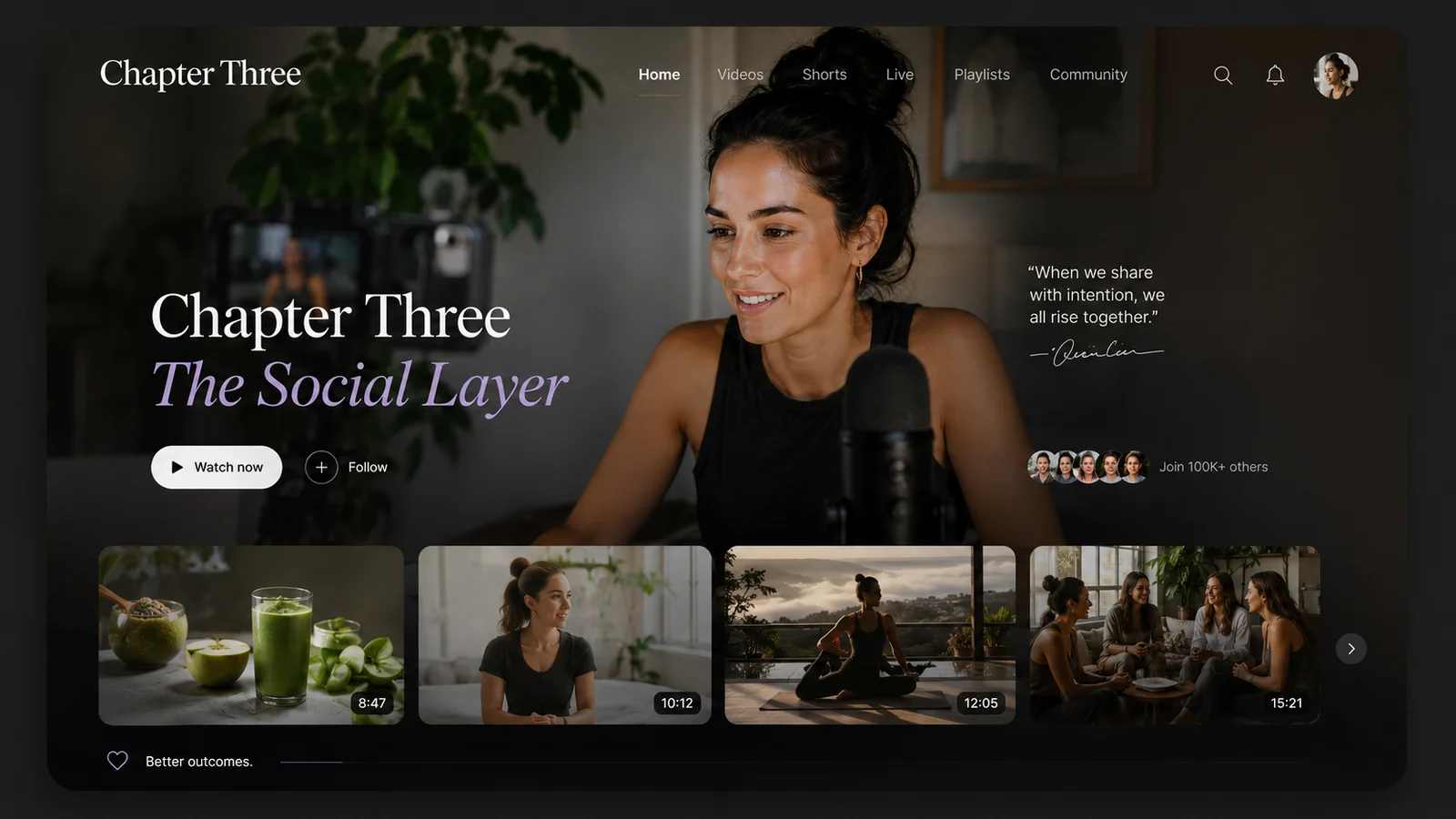
AI is not going to solve consumer health.
Let me be clear about what I mean. AI will help. It will make health information cheaper, faster, more personalized, more abundant. We will get plans, predictions, summaries, and recommendations at a price that would have been unthinkable five years ago. That's real, and it matters.
But we already have more information than we know what to do with.
People walk around with lab panels from Function, glucose curves from Levels, recovery scores from Whoop, sleep stages from Eight Sleep, supplement stacks from podcasts, and protocols from creators they follow. They have dashboards. They have apps. They have personalized plans.
And still, most people are stuck.
What I thought two years ago
Two years ago, I wrote that I was dedicating the next chapter (i.e. Chapter Two) of my career to accelerating consumer health. Back then, I thought that mostly meant better diagnostics, better products, better data, better access. And to a degree, that's more true than not. I spent the last couple of years helping build it at Function Health, where the thesis is that giving people their full biological picture would change what they did about it.
I still believe in that picture. But I've come to believe something else more strongly.
The bottleneck is not the result itself. It's what happens after.
It's the day after you get the lab report. The dread of the numbers gives way to the regular pull of life, and the abnormal slips into background.
It's the week after you buy the wearable, when the novelty wears off and the app becomes one more thing to ignore. The graphs are still there. They are objectively useful. You stop opening them.
It's the moment you're alone in your kitchen, tired, trying to turn a "personalized plan" into dinner. The plan is correct. The plan is also abstract. The plan does not pick up groceries.
That is where consumer health breaks.
Not because the insight is wrong, but because insight is not the same thing as change.
A blood panel can tell you precisely where your health stands. It cannot tell you what your evening looks like when willpower is low and you've been on calls since eight a.m. It cannot insert itself between you and the takeout menu. It cannot replace the friend who texts to ask how your sleep was last night, or the trainer expecting you at six, or the colleague who's also trying to cut sugar.
The other thing we keep missing
Underneath all of this is a harder truth: consumer health cannot just be about optimization.
The optimization frame has become the dominant register because it's where the early adopters live: people with disposable income, status interest, and time to read about NMN. That's a real market, though it's not the only one nor is it even the most consequential one.
Most people don't engage with "consumer health" because they're trying to optimize. They engage with it because they're afraid. Of getting sick. Of being hit with a bill they can't handle. Of falling through the cracks when life gets messy and the system that's supposed to catch them doesn't.
Better biomarkers and better plans matter. But they don't mean much if people still feel alone when something goes wrong. The next chapter of consumer health has to touch the thing people are actually scared of, not just optimize the version of life where everything is going fine.
So I think the real opportunity has shifted.
Less about giving people more things to optimize. More about changing the environment around them: who they hear from, who they trust, who they do it with, and what starts to feel normal.
Where creators come in
Not as influencers in the shallow sense. As the people already shaping attention, language, habits, aspiration, and belonging.
A creator can take something abstract and make it feel doable. They can make a new behavior, like protein at breakfast or sleep before midnight or weights three times a week, feel less clinical and less lonely. More like something a real person you respect does in their actual life. They can make care feel like something that happens with you, not just to you.
This is the part I underestimated two years ago. I framed creators as a marketing layer, the new way health brands would reach people. I now think that's a small part of what's actually happening.
Creators are not just a new distribution channel for health products. They are a way to rebuild the missing social layer around health itself.
For most of human history, health was social. You had a village, a family doctor who knew you for decades, a community whose habits you absorbed without thinking, neighbors who would notice if you stopped showing up. Industrialization, urbanization, and a healthcare system that gives you twelve minutes with a stranger every two years have eroded that to almost nothing. We have more information than ever and less context than ever. That's the trade we made.
AI can generate the recommendation. AI can summarize the protocol, personalize the plan, predict the lab value, write the meal plan, schedule the workout.
But the thing that makes anyone follow through, the gravity that holds a habit in place when motivation fails, the relationship that makes you show up on a Tuesday in February when nothing in particular is wrong, is still social. That part still belongs to humans. And specifically, it belongs to the humans whose voices a person has chosen to invite into their head.
That, I think, is where consumer health finally starts to accelerate.