Essay · August 23, 2026
Escape Velocity
The other viral in health.
Escape velocity is the speed an object needs to break free of a gravitational field.
American healthcare has a particularly strong one.
Reimbursement. Regulation. Employers. Insurers. Health systems. Clinical workflows. Procurement cycles. Legacy infrastructure. Trust. Human behavior.
For decades we have thrown increasingly powerful technology at that field. Better drugs. Better diagnostics. Telehealth. Wearables. Digital health. Now AI.
Each one adds velocity.
Very few things actually escape.
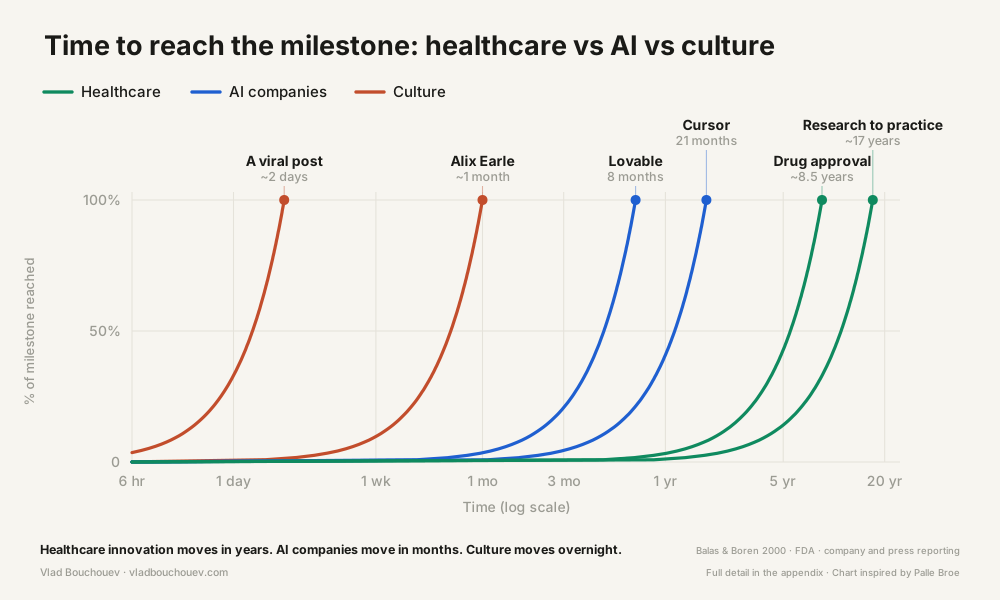
The timelines are not close
The most-cited estimate for how long it takes published research to reach routine clinical practice is seventeen years. That figure comes from Balas and Boren in 2000 and has been cited more than two thousand times. A 2021 study looking at cancer control put it closer to fifteen. People argue about the methodology. Nobody argues it is fast.
A new drug takes roughly eight and a half years to move from the start of clinical testing to approval, and that is only the part the FDA measures.
Now hold that against what has happened somewhere else entirely.
Cursor reached $100 million in annual recurring revenue in January 2025, the fastest any software company ever has. Thirteen months later it was at $2 billion. Lovable got to $100 million in eight months and is tracking toward roughly $600 million by the end of this month, less than two years after launch.
These are not adjacent numbers. They are not on the same axis. Healthcare measures progress in years and AI companies measure it in months, and the gap is not closing because one side is trying harder.
And yet I have started to wonder whether all that speed is aimed at only half the problem.
What AI actually multiplies
AI makes health intelligence abundant. It reads labs, synthesizes literature, drafts the prior authorization, personalizes the protocol, and collapses the cost of building software to something close to zero. All of that is meaningful and I am not arguing against any of it.
But abundance of intelligence is a supply-side victory.
I wrote about this in Chapter Three: the bottleneck is not the result itself, it is what happens after. Insight is not the same thing as change. You can hand someone a perfect picture of their own biology and watch nothing happen, because the plan is correct and the plan is also abstract, and the plan does not pick up groceries.
That essay was about why a person does not change.
This one is about why the system does not move.
They are different problems. The first is behavioral and it happens in a kitchen. The second is structural and it happens across an industry that has spent a century building the gravitational field described above. More intelligence, arriving faster and cheaper, does not obviously solve the second one. It gives us more to build with. It does not change what people believe, demand, or ask for.
There is one technology that does.
The other viral
In health, viral means something you catch. A thing to be contained.
There is another kind. Over the last decade, social media has become the most powerful distribution mechanism we have.
In late 2022 Alix Earle was a college student in Miami whose TikToks had started to work. Within roughly a month she added more than two million followers. A prebiotic soda brand ended up in her videos, first organically, then as a partnership, then as an equity position she announced in 2024. She did the Super Bowl ad in February 2025. In March, PepsiCo agreed to buy Poppi for $1.95 billion. The deal closed in May. Reporting put her own outcome somewhere between $20 and $40 million.
To be clear about what that does and does not prove: Alix Earle did not build Poppi, and TikTok did not create a two billion dollar company on its own. Poppi had a product, a category tailwind, and years of work behind it.
But something happened there that is worth sitting with.
A young brand used culture to attack a category built by companies that spent a hundred years perfecting physical distribution. Shelf space, slotting fees, bottler relationships, cold chain. All of it, still there, still expensive. And a different distribution system moved faster than any of it.
The pattern is already in health
This is not a beverage story. The same mechanism has been running in health-adjacent categories for years.
Creatine went from a bodybuilding supplement to something recommended for cognition and healthy aging. Protein was rebranded from a fitness input into a general-purpose virtue. Cold plunges appeared in suburban backyards. Continuous glucose monitors became cultural objects worn by people with no metabolic condition at all. A meaningful number of people now know what HRV stands for and check it before deciding whether to train.
Not one of those shifts was driven by a clinical guideline, a payer decision, or a health system rollout.
Those are all low-stakes. The obvious objection is that culture can move a powder or a gadget but not medicine.
The clearest counterexample is a prescription drug. Semaglutide was approved for diabetes in 2017 and for obesity in 2021, on trial results that were genuinely exceptional. It grew quickly on that evidence. Then it stopped being a drug and became a topic, and the curve bent again. Prescriptions, searches, and celebrity stories started moving together. Whatever you think of that as medicine, it is the clearest recent case of something genuinely clinical reaching escape velocity, and it did not get there on evidence alone.
A supplement, a protocol, a diagnostic, a behavior, or a drug can go from obscure to unavoidable in a matter of weeks.
Healthcare has known this for decades. Direct-to-consumer pharma advertising has been legal here since 1997 and runs to billions a year. It works, which is why it survived.
But you have to rent it. You never own the audience, you are leasing access to someone else's, and when the spending stops you have nothing left. You can only rent it at the end, too: nobody buys a pharma ad without an approved product, so it is a tool for companies that have already won. And everyone watching knows it is an ad, so none of the trust comes with it.
Manufacturing demand in health is not new. What is new is that it got cheap, fast, and trusted at the same time, and that it now works for people who have nothing to sell yet.
Sometimes the underlying science deserves every bit of the attention.
Sometimes it very much does not, and that is the honest cost of this mechanism. The same velocity that can move a good idea will move a bad one just as efficiently, and the correction arrives long after the trend has.
But the velocity itself is not in question.
Supply and demand
Here is the formulation I keep coming back to.
AI multiplies supply. Social multiplies demand.
AI gives us more capability per dollar and per engineer than any technology in my lifetime. Social gives an idea the ability to reach and change a few million people before an institution has scheduled the meeting about it.
Healthcare does not only have an information problem. It has a behavior problem, a trust problem, and a distribution problem, and those three are the ones that make the gravitational field strong. Capability alone has never been enough to break out of it. We have run that experiment repeatedly and mostly produced very good technology orbiting a system it never escaped.
So maybe the problem was never a lack of thrust.
Maybe what is missing is a second engine.
The question I am more interested in
For a few years the industry question has been what AI will do to healthcare. It is a good question and a lot of serious people are working on it.
I have become more interested in a different one.
What happens when AI meets virality?
What does it look like when the cost of building something genuinely useful falls to nearly nothing, and the cost of making a few million people want it falls at the same time? When the thing that changes behavior is not a benefit design or a clinical pathway, but a person somebody already trusts?
There is also a less patient version of this argument. I am 35. If a good idea in health takes seventeen years to reach half the people it should reach, I get two or three more completed swings at this. That arithmetic is why incrementalism has stopped feeling like the safe option to me, and started feeling like the one that guarantees you run out of time politely.
I do not think this combination has been seriously tried in health. I think it is the only one with enough force to get something out of orbit.
Appendix · what each line measures
The chart is illustrative. The endpoints are sourced; the curve shapes between them are drawn, not measured.
Research to practice. Time from a landmark trial's publication until 50% of eligible patients are receiving the intervention. 15.6 years across nine mostly primary-care services, plus 1.4 years from submission to publication, which is where the familiar 17 comes from. Balas and Boren, 2000. The methodology has fair critics.
Drug approval. Start of clinical testing through FDA review, roughly 8.5 years. FDA. This excludes discovery and preclinical work, so it understates the full timeline.
Cursor. Launch to $100M ARR, reached January 2025, the fastest any software company has. $100M to $2B took about thirteen more months. Value Add VC.
Lovable. Launch to $100M ARR in eight months, tracking toward roughly $600M. Worth flagging: the $400M figure circulating is the Series C raised in August 2026 at a $13.3B valuation, not revenue. TechCrunch.
Alix Earle. Over two million TikTok followers added in roughly a month during her late-2022 breakout. Background. PepsiCo agreed to acquire Poppi on March 17, 2025 at $1.95 billion and closed on May 19. PepsiCo. Her equity stake and reported outcome via Fortune.
A viral post. Illustrative rather than a specific case.