Essay · August 28, 2026
The Ownership Ladder
From ad read to cap table to lab.
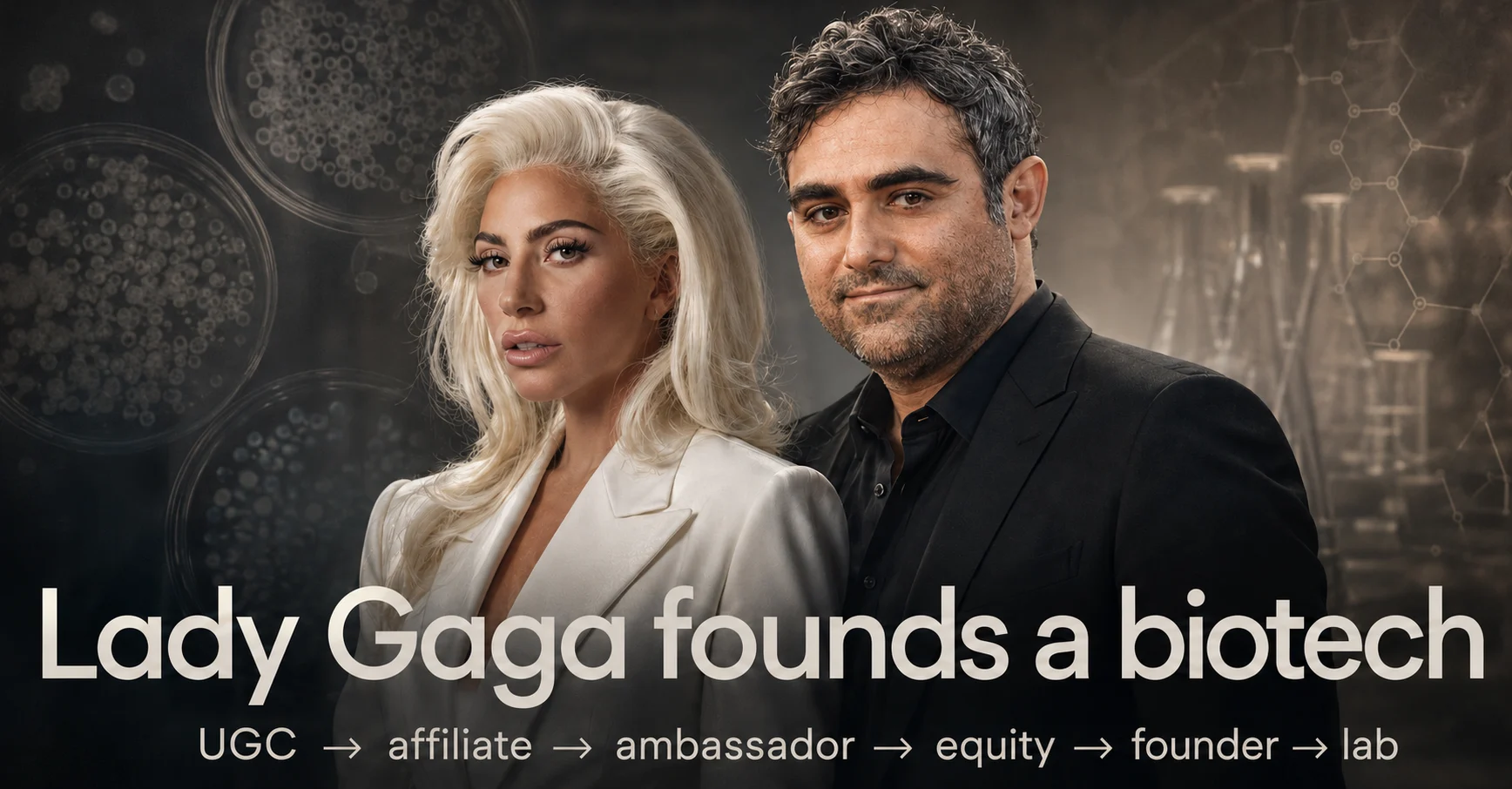
Lady Gaga founded a biotech.
Okay, sort of.
The story broke late last year, in a Rolling Stone profile, and then mostly sat there. Gaga had secretly co-founded Outer Biosciences, a skin-health company run by her fiancé Michael Polansky. Her official title is board member. But Polansky added the detail that makes it interesting.
"It was her idea."
Skin removed from the body normally dies inside a week. Outer keeps surgically discarded tissue alive for about four, runs experiments on it, and trains models of skin biology on what comes back. The company spent years in stealth before saying any of this out loud.
Poker Face to cap table to petri dish.
A pop star starting a tissue-engineering company should have been a bigger story than it was. I think the reason it slipped by is that we do not have a category for it yet. We have a category for celebrities who endorse things, and a newer one for celebrities who invest in things. We do not really have one for a musician whose idea becomes a lab.
The first rung was the investor
Fifteen years ago Ashton Kutcher made the celebrity tech investor normal. A-Grade Investments turned a famous person into a name on a cap table, and the interesting part was never the money. Plenty of people had money. The interesting part was that his attention was worth something to the companies he backed, and everyone involved understood that was the actual asset.
Athletes followed, and they followed harder. Kevin Durant's Thirty Five Ventures put him into WHOOP and Therabody, which are not random consumer bets. They are companies whose customers look like his audience.
Then it got more explicit. Serena Williams became the face of Ro's GLP-1 push, in a campaign that ran through last August and into a Super Bowl spot this February. Alexis Ohanian was already an investor in Ro, and on the board. The distance between "person in the ad" and "person on the cap table" collapsed to nothing, inside one household.
The creator economy climbed the same ladder, faster
The rungs are well worn by now.
UGC, then affiliate, then ambassador, then equity, then founder.
Alix Earle walked most of it in public. A prebiotic soda showed up organically in her videos, then as a partnership, then as an equity position she announced in 2024. PepsiCo bought Poppi for $1.95 billion last year.
Hailey Bieber skipped the middle entirely and built the company. e.l.f. acquired Rhode in a deal announced last May worth $800 million in cash and stock at closing, with another $200 million tied to performance. Rhode had done $212 million in revenue in the preceding twelve months. That is not a licensing deal with a famous name attached. That is an operating business that happened to be founded by someone with distribution.
And now there is infrastructure for it. Jeff Frommer launched OWM last September around exactly this premise: a standardized influence-for-equity agreement, thousands of creators, hundreds of startups, and matching software to pair them. His own word for it is the ownership economy. The agencies are already inside it.
The premise is almost embarrassingly simple.
If you create the demand, why would you not own some of the supply?
In the first era of social media, creators rented their distribution out by the post. Make the content, drop the link, collect the check. Then the affiliate link became equity. Equity became a company. Gaga points at the rung above that: upstream of the product entirely, into research and IP.
Why health is where this gets strange
I wrote in Escape Velocity that healthcare's problem is not a shortage of capability, it is a shortage of distribution that anyone trusts. Creators are already the distribution. They are upstream of an enormous amount of health behavior before the healthcare system enters the conversation at all.
Protein. Sleep. Creatine. Fertility. Glucose. GLP-1s. Longevity.
None of those became mainstream because of a guideline or a payer decision.
For decades a health company built the product first and worked out distribution afterward, which is why so much good technology never reached anyone. Social media scrambled that order. Someone can now assemble an audience around an unmet need before a company exists to serve it, and sit with that audience for five years, which is five years of unstructured market research that no deck can buy.
That changes what a founding team can look like. The next serious health company will still have the PhD and the clinician and the operator who has run a regulated business before. But the person sitting next to them might have eight million followers, a fund, and the ability to move a few million people with one post.
Where this ends up
The ladder now reads:
UGC, affiliate, ambassador, equity, founder, lab.
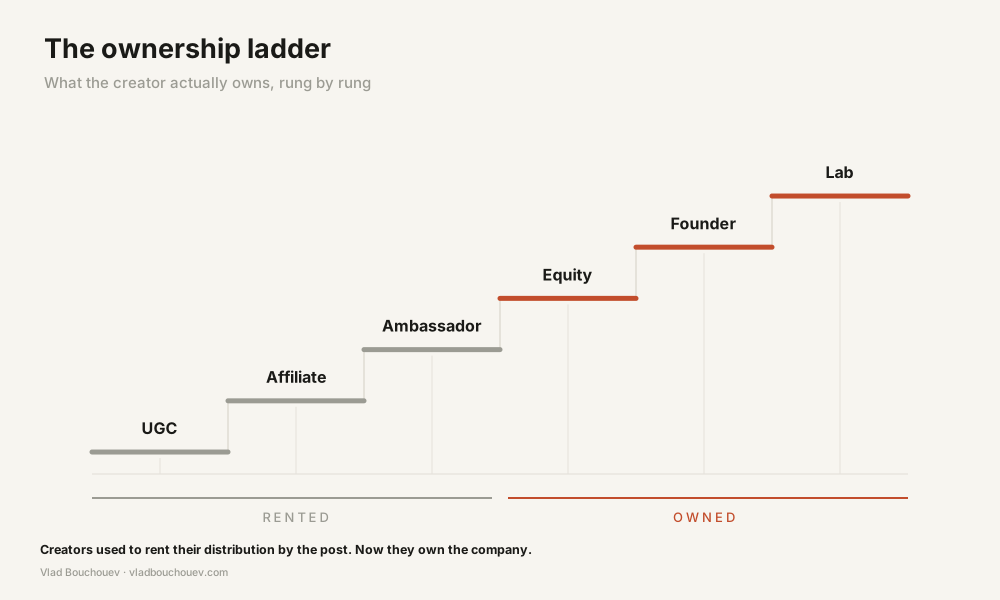
Gaga is an unusual case. I suspect she is also an early one. The logic that took creators from ad reads to cap tables does not stop at cap tables, and health is the category where the distance between what people believe and what they do is widest, which makes it the category where owned distribution is worth the most.
A bad romance between creators and healthcare.
We are going to see a great deal more of it.